

Somewhere in your home there is a passport in one drawer, a lease in an email attachment, an insurance policy in an online account and a vaccination record you last saw two addresses ago. Before a move, that scatter is the real risk, because paperwork is easiest to lose when boxes are being packed around you.
This guide shows you how to organise important documents before a move without turning it into a project. You will set up five paper categories with matching digital folders, create secure and tested backups, and put together one document kit that stays with you from the old house to the new one. It is written with Australian households in mind, and each step should take an evening or two rather than a weekend.
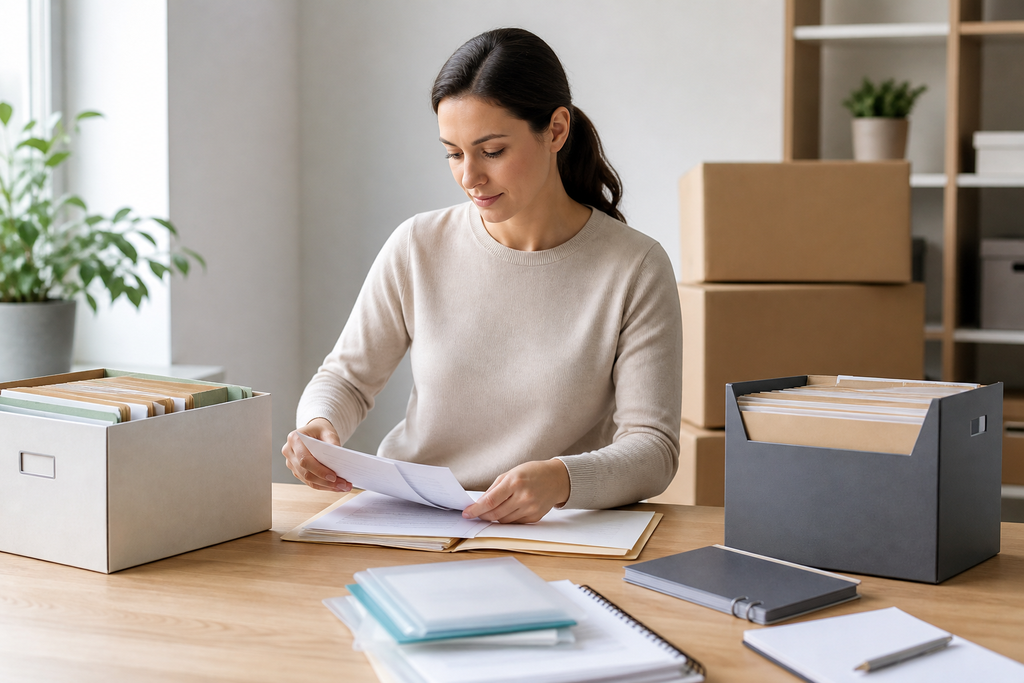
Organise important documents before a move into five simple categories
Start by gathering everything in one place when organizing your important documents before a move. Pull paperwork from drawers and existing files, then download relevant attachments and records from your email and online accounts into a single secure working folder. Once it is all on one table, sort it into five labelled folders: identity (passports, birth certificates), home and move (leases, purchase or settlement paperwork, removal bookings), money (financial records), insurance (policies and contact details) and health (essential medical records).
Next, split every document into one of three piles. Keep-original is for irreplaceable or legally required papers, such as passports and birth certificates. Scan-and-keep means you make a digital copy but hold on to the paper as well, and securely-destroy is for sensitive papers you have confirmed you no longer need, which you shred rather than bin.
Be cautious with that last pile. Before discarding financial or legal records, check the current Australian retention requirements with the relevant authority or your adviser, because rules vary by document type. A scan does not automatically replace an original you are required to keep, so never shred something simply because you have photographed it. Anything you retain goes straight into its category folder.
Create readable digital copies that match your paper files
Scan every document you are keeping, including all pages and any reverse sides that carry information. Zoom in before saving to check that small print, signatures and document numbers are legible, since a blurry copy is little help when you need the details quickly. If you do not have a scanner, a clear photo of the front and back of each item is a reasonable minimum.
Then mirror your paper system. Create digital folders with the same five category names, and name files in a consistent category-document-date pattern, such as home-lease-2026-04-15.pdf, so a file is easy to find whether you remember the category or just the document.
Protect the folders with a strong password and encryption, and switch on multi-factor authentication where it is offered. Keep one additional secure backup separate from the device you scanned on, so a single lost laptop or phone does not take everything with it. Finally, test it before moving day by signing in and opening a few files from the device you will be carrying, and confirm your authentication method, such as a code sent to your phone, will still work during the move.

Carry your essential document kit and give it a secure home on arrival
Build one discreet, water-resistant folder or pouch for the things you cannot replace easily or will need straight away. That means originals such as passports and birth certificates, plus your lease or settlement details, the removal booking, insurance contacts and essential health information. Keep it in a bag you control personally, never in removal boxes, the storage load or an unattended vehicle, and remember that a single folder is easier to track than several.
This is also where coordination with your removalist matters. When you confirm packing and loading arrangements for a residential move, tell them clearly that the personal document kit is excluded from packing and storage, and put it aside, ideally with your handbag or overnight bag, before the crew starts. Adlam Transport’s document-preparation guidance (https://adlamtransport.com.au/how-to-organize-your-important-documents-before-a-move/) covers the same preparation ahead of a removal, and is a useful companion to this checklist.
On the morning of the move, run a quick check: confirm the kit holds the essentials, keep it with you, and verify you can still open your digital backup. On arrival, check the contents again, then move the paper folders into a secure permanent home, such as a lockable cabinet, keeping the same categories digitally.
Finish with a short address-update list:
1. Government records, including your driving licence and Medicare where applicable.
2. Banks.
3. Insurers.
4. Healthcare providers.
Check each organisation’s process rather than assuming one update will reach everyone.Read more at https://myflashyhome.net/.