

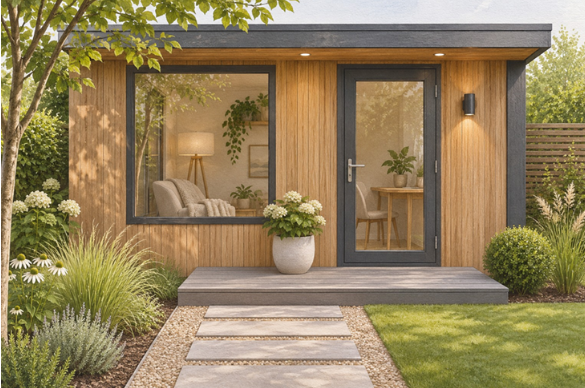
A garden studio usually starts with a lovely idea: somewhere quiet to work, paint or finally give a hobby its own room. Then the building arrives, the desk goes in, and the patch of ground outside the door gets left for another weekend. That unfinished entrance soon becomes the part you notice most. You’re balancing a mug while finding your keys, stepping around a puddle or asking a visitor to use the other gate.
Good garden studio entrance ideas deal with those little annoyances. The entrance should make the room easier to use and help it belong in the garden. You can achieve a lot with a sensible path, a properly planned landing and a few well-placed finishing touches. The trick is deciding how the space needs to work before buying the things that will fill it.
Picture an ordinary arrival
Think about the last few steps of the journey. Where will you stand while opening the door? Can you put a bag down without leaving it in the wet? If someone is already on the landing, is there room to pass?
These questions matter more than the exact shape of a planter. Mark the proposed landing on the ground and open the studio door fully. Walk across the area carrying something bulky, then try it with another person. A space that looked generous on a drawing may feel quite different when a door, chair and visitor all need room at once.
The studio’s purpose changes the answer. A private reading room may only need a modest landing. A garden office used for appointments needs a clear arrival point and somewhere for a guest to pause. Plan for the life you expect the room to have, including the less tidy moments.
Connect the door to the rest of the garden
The landing is only as useful as the path leading to it. If you cross a lawn every morning, look at where your feet naturally go. That worn line may tell you more about a useful route than a winding path chosen mainly for appearance.
Keep the approach comfortable for its intended users. Loose gravel may suit a planting area but make a poor choice along a route used by wheels. Narrow gates, overhanging branches and an awkward turn can also undermine an otherwise thoughtful entrance. Consider the whole journey from the house or side gate, rather than stopping the design at the edge of the studio.
Watch the area after rain before finalising surfaces. Water gathering beside the threshold needs an answer in the construction, not another mat inside the door. Coordinate drainage and levels with the person installing the building or landing so the finished details work together.
Choose a surface you want to live with
Materials bring different care requirements as well as different colours. Timber can give a familiar garden feel, while paving may connect neatly with an existing patio. For homeowners exploring a board finish, NeoTimber’s composite decking provides a range to compare alongside the rest of the project.
Take samples outside. A grey that looks soft indoors can feel much stronger beside pale studio walls, and a warm shade may look different under surrounding trees. Leave the samples in place through different parts of the day rather than making the decision from a phone screen.
Ask what the complete installation includes. Boards, supporting structure, fixings and edges all contribute to the result, so compare full specifications when reviewing quotes. Keep the manufacturer’s guidance for spacing and cleaning. Even a relatively easy-care surface needs ordinary attention, especially where leaves and soil collect around a garden building.
Make room for the things people carry
A bench by the studio can be useful, but think about its job. If it mainly holds a bag while you unlock the door, it belongs within easy reach. If it’s somewhere to sit with a coffee, a position away from the main approach may be more comfortable.
The same logic applies to storage. Outdoor shoes need a different home from sketchbooks or client paperwork. Hooks inside can take coats without occupying the worktop, while an appropriate outdoor box may suit less sensitive items. Avoid buying a large storage bench simply because it matches the decking; check that its lid opens comfortably in the available space.
Leave some of the landing empty. It’s easy to underestimate the value of clear floor space until you’re carrying a parcel or welcoming two people at once. One substantial planter can give the entrance character without creating a collection of small obstacles around the door.
Help first-time visitors feel expected
If the studio is part of a home business, a visitor shouldn’t have to guess whether to knock at the house or continue into the garden. Send short arrival instructions and check that the property itself supports them. The correct gate should look like a route people are welcome to use.
For a business entrance, professionally made signage from a supplier such as Alpen Signs can provide a clear name or direction. Work out the wording first. A readable business name and arrow may help more than an elaborate sign carrying every service you offer.
Place information where someone needs to make a decision. A sign immediately beside the studio door cannot solve uncertainty at the side gate. Keep the scale appropriate to the property, check relevant local restrictions and avoid displaying private household information unnecessarily.
Let light and planting finish the entrance
Lighting is easiest to judge when you actually walk the route after dark. Look for a hidden step, a shaded gate latch or a door handle that disappears into the wall. Those are useful places to focus attention before adding decorative lighting elsewhere.
Outdoor electrical work needs suitable fittings and a qualified installer. Consider neighbouring windows when choosing positions, and make the controls convenient for your routine. A studio used on winter evenings needs an entrance you can find comfortably on the way out as well as on the way in.
Planting can soften the building without hiding its practical edges. Repeat something already growing in the garden to help the new room feel connected. Check mature plant sizes, keep the door swing clear and leave access to ventilation openings and the building base. Pots also need watering arrangements that don’t leave the approach constantly damp.
About NeoTimber
NeoTimber supplies outdoor products across decking, cladding, fencing, balustrades and furniture. Its decking resources include samples, calculators, installation information and care guides, which give homeowners several ways to prepare before choosing a system.
For a studio entrance, the useful starting point is a sample beside the actual building and a clear specification for the whole landing. Use NeoTimber’s product information to discuss the proposed layout with your installer, including the support and finishing details. This keeps the decision grounded in the entrance you need rather than a colour choice made in isolation.
Give the entrance time to settle
Finish ground preparation and essential construction before making the final decorative purchases. Then use the entrance for a week or two. You may find that a chair belongs on the other side, the main planter needs moving or a hook would solve the daily bag problem.
Try the route in the conditions that used to make it awkward: with an umbrella, a full shopping bag or a visitor unfamiliar with the garden. When those arrivals feel straightforward, the entrance is doing its job. The studio becomes somewhere you can step into easily, even on a busy morning when you haven’t stopped to admire it.Read more at https://myflashyhome.net/