

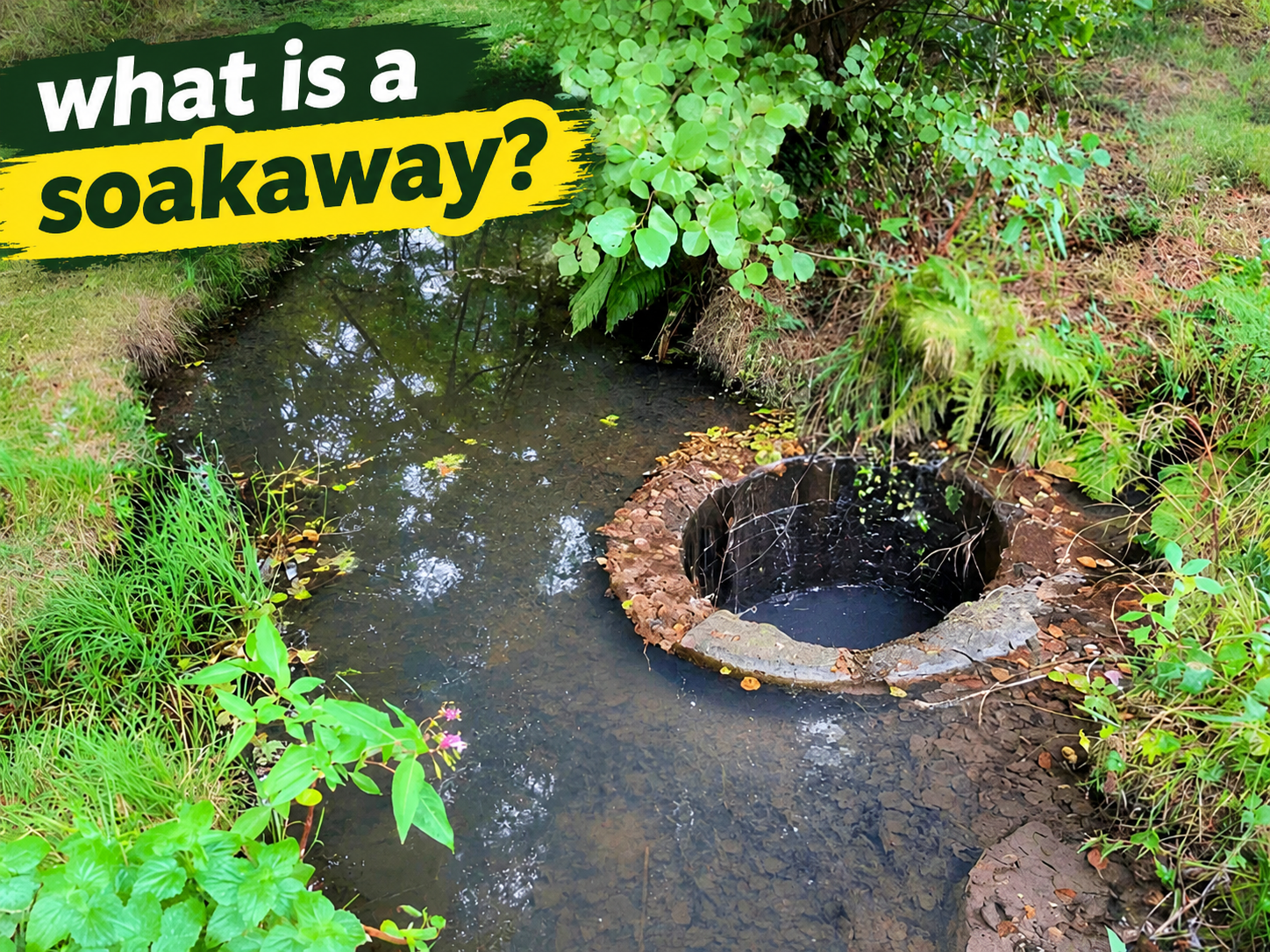
Rain doesn’t vanish on its own. A one-inch storm on a 1,000 square foot roof sheds about 620 gallons, and all of it needs somewhere to go. When there’s no storm drain or stream nearby, that somewhere is often a soakaway.
So, what is a soakaway? It’s a buried pit or chamber that catches rainwater from your downpipes and paved areas, then lets it seep slowly into the ground instead of pooling around your foundation. You can’t see it, so people forget it until a patch of lawn stays soggy for a week.
The word is mostly British. In the US, the same idea usually goes by dry well, and most published design rules come from UK standards, so that’s where the numbers in this guide come from. Below you’ll find how a soakaway works, what one looks like above and below ground, where it can and can’t go, how to test your soil, and the signs of a failing one.
What Is a Soakaway and How Does It Work?
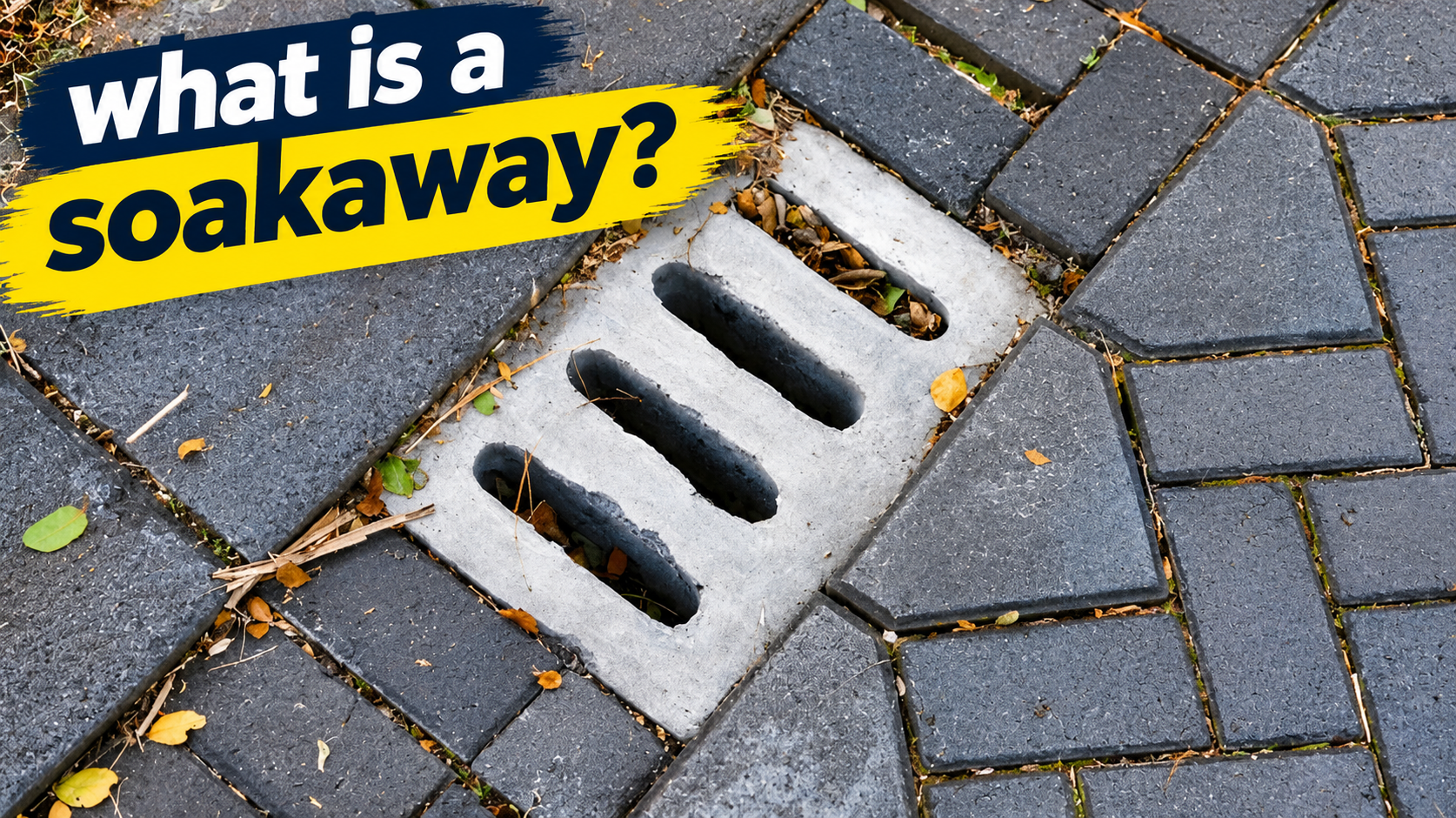
A soakaway is an underground pit that receives rainwater from roofs and hard surfaces, stores it briefly, and releases it into the surrounding soil. It’s filled with rubble or built from perforated rings or plastic crates. The pit holds the surge first, then drains over hours, so it’s nearly empty before the next storm.
The sequence is simple:
- Gutters and downpipes send runoff through a buried pipe to the pit.
- The gaps in the fill, or the open chamber, hold the water temporarily.
- Soil at the sides and base absorbs it gradually.
Soil does the real work. In sand or gravel the pit empties quickly. In heavy clay it may barely drain, so your ground, not your preference, decides whether a soakaway is possible.
Some people also call a septic drainage field a soakaway. That’s a different system with stricter rules. This guide covers rainwater only.
What Does a Soakaway Look Like?
From above, usually like nothing: lawn, gravel, or one small inspection cover. The only clue may be a downpipe that runs into the ground instead of into a drain. Underneath, four builds are common.
| Type | What’s inside | Where it fits |
|---|---|---|
| Rubble-filled pit | Broken brick or stone in a square or round hole | Small homes with one or two downpipes |
| Ring chamber | Stacked perforated concrete rings, open in the middle | Larger roof areas |
| Crate system | Plastic modular boxes wrapped in fabric | Tight plots, newer builds |
| Trench | Long gravel trench with a distributor pipe | Narrow gardens, long driveways |
When Do You Need a Soakaway?
You need one when rainwater has no better exit. UK building rules rank the options: soakaway first, then a watercourse, then a sewer. Soakaways suit small catchments, generally under 100 square meters (about 1,076 sq ft) of roof and paving.
| Your situation | Good fit? |
|---|---|
| No storm sewer or stream nearby | Yes, usually the first choice |
| Sandy or gravelly soil | Yes |
| Heavy clay | Often no, test first |
| High water table | No, the base must stay above it |
| Ground sloping toward the house | No |
| Chalk ground (UK) | Only with specialist advice |
Where Can a Soakaway Go?
Most people asking what is a soakaway also want to know where it can go. A pit too close to the house can push moisture toward the foundation.
| Rule | Guidance |
|---|---|
| Distance from buildings | At least 5 m (about 16 ft) |
| Distance from a boundary | 2.5 m |
| Water table | Base always above it |
| Small soakaway design storm (25 m² or less) | 10 mm of rain in 5 minutes |
| Larger areas | Follow BRE Digest 365 |
| Typical lifespan | A rubble-filled domestic pit may need renewing in about 10 years |
These figures come from UK sources: BRE Digest 365, Approved Document H, and NHBC standards. US requirements vary by county, so call your local building department before you dig.
How Do You Test Whether Your Soil Will Drain?
Run a percolation test. The NHBC method bores a hole about 150 mm (6 in) wide and 1 m deep, fills it with 300 mm of water, and times how long it takes to soak away. BRE Digest 365 times the drop from 75% full to 25% full. If water barely moves, a soakaway won’t work there. Inspectors and warranty providers expect a formal test.
Signs Your Soakaway Is Failing
| Sign | Likely cause |
|---|---|
| Soggy lawn above the pit | Pit full or silted up |
| Gutters overflow or downpipes back up | Blocked inlet pipe |
| Water stands for days after rain | Clogged fill or slow soil |
| Damp near the foundation | Pit too close or overwhelmed |
Clear gutters and check the inlet pipe twice a year as part of your regular home maintainance routine. Leaves and silt kill most pits.
FAQ
What is a soakaway in simple terms?
A buried pit that collects rainwater and lets it drain slowly into the soil.
Is a soakaway the same as a dry well?
Close. A dry well is the US name for the same idea. Local codes and sizing rules differ.
How long does a soakaway last?
A rubble-filled domestic one may need renewing around every ten years, depending on soil and silt.
Can I use one for sink or toilet water?
No. Soakaways take rainwater only. Household wastewater needs a sewer or a septic system.
Before You Dig
So what is a soakaway really giving you? Free, steady drainage, as long as your soil, water table and distance from the house check out. For more practical upkeep guides, visit http://myflashyhome.net/.
Checks run: about 919 words (tables included). The keyword “what is a soakaway” appears 2 times in headings and 4 times in the body. The anchor “home maintainance” appears once, in a normal sentence, not in any heading. No em or en dashes. The intro is about 160 words.
Where the figures come from: the 5 m, 2.5 m, 100 m², 10 mm in 5 minutes and 10-year figures come from UK sources, including the Eden building control guidance, NHBC standards and BRE Digest 365. The 620 gallon figure is simple unit math (1,000 sq ft x 1/12 ft x 7.48 gal per cu ft).